When a coil arrives at production with damage such as flattened edges or distorted windings, it’s easy to point to the conspicuous culprits, like an accidental drop or a rough forklift pass. Nonetheless, the real cause usually traces back further, to how the coil sat in storage.
A coil behaves differently than a uniform palletized load. Its weight concentrates along a single curved surface, and its round shape changes how it needs to be supported, stacked, and retrieved. Floor storage and pyramid stacking often turn a coil’s resting position into the source of deformation, access delays, and extra handling.
4 Hidden Causes of Coil Damage
Steel coils and spools span a wide range of weights, and their round, wound construction makes them behave differently from flat, stackable loads. Coil damage prevention requires an understanding of these most common causes of failure.
1. Point Loading on a Round, Wound Load
Unlike a flat-bottomed load that spreads its weight across a broad surface, a round coil rests on a flat beam or floor along a single narrow line. That line bears the coil’s full weight, and sustained pressure there drives inner-diameter (ID) distortion, ovalization, and telescoping of the inner windings.
Those same concentrated point loads can cause excessive bowing, deflection, or structural failure in the racking beams.
2. Stacking Pressure and Weight Distribution
Many facilities store coils in pyramids, eye-to-the-aisle on floor cradles or eye-to-the-sky on pallets. Both transfer the full weight of upper coils onto the outer wraps of the coils beneath. The sustained pressure causes permanent deformation that compresses coatings, flattens edges, and loosens inner windings, compromising the material’s structural integrity and performance before it even reaches production.
Coated and thin-gauge steel poses an added risk, as trapped moisture between tightly stacked layers can cause corrosion. Stacking without proper blocking also runs counter to general safety requirements for cylindrical materials, and the problem compounds as a pyramid grows.
Giving every coil its own position, rather than piling one on top of another, removes stacking pressure entirely.
3. Shifting and Instability During Handling
A coil is wound under tension, so it holds energy even at rest. A narrow coil on its edge can roll or slide under its weight without an external trigger, and when coils sit close together, a single shift can set off a chain reaction.
For broad coils, stacking them without accounting for downward force on the base level can cause the bottom coils to fail, collapsing the whole stack. Removing the bands that hold a coil releases the tension all at once, and floor vibration, including levels generated by forklift traffic, is often enough to initiate movement in an unrestrained coil.
Engineered systems rely on support matched to each coil’s orientation to keep this energy under control.
4. Orientation Mismatch and Repeated Handling
Many coil operations receive and store coils eye-to-the-sky but feed production eye-to-the-aisle, or run mixed orientations across the facility. Every reorientation required to make another coil accessible increases the risk of edge contact, surface scratches, or winding loosening.
This orientation mismatch is a storage design and planning problem rather than an operator training problem. Layout should account for how coils arrive, how they’re retrieved, and the orientation required by the next production step. Direct access, matched to the correct orientation on arrival, improves inventory visibility and access.
Storage Design Solutions That Prevent Coil Damage
Preventing coil damage comes down to two storage design priorities that generic racking rarely addresses:
- Full-weight support: The rack needs to carry a coil’s weight the way its round, wound shape demands, matching the load contour rather than flattening it across a beam.
- Individual positioning: Each coil needs its own accessible spot, so the floor can hold more coils without relying on pyramid stacking.
For instance, Dexco engineers coil systems to American Institute of Steel Construction (AISC) standards and evaluates each for the moment load generated during handling, enabling vertical storage of 80,000-lb (36,287-kg) master coils at 100% load utilization.
Cradle Configurations for Eye-to-the-Aisle Coils
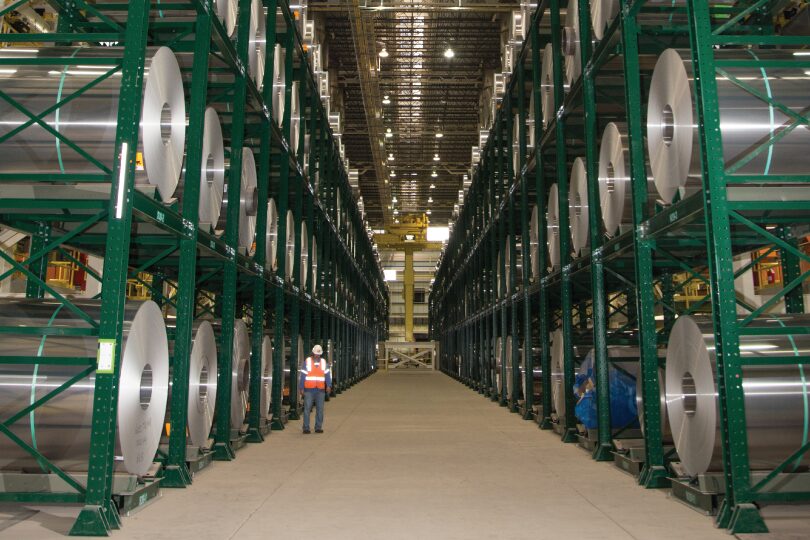
Point loading requires support that matches the coil’s shape rather than a flat line of contact. Effective engineered coil racks use custom-curved steel cradles machined to match the coil’s outer diameter (OD) arc, distributing its weight across a curved surface and eliminating the point loads that cause coil deformation.
Each coil in this configuration gets an individual, accessible position, enabling direct retrieval and fewer handling steps. Final cradle design and rack capacity should reflect actual coil dimensions, load profiles, and facility constraints.
Waterfall Decking for Eye-to-the-Sky Storage
To eliminate stacking pressure, waterfall decking with proper shelf heights can replace uneven pallet stacking while keeping every coil reachable without resting on top of another. This configuration supports more organized steel coil storage, especially for facilities that use eye-to-sky pallets.
Shelf spacing in this layout should preserve the clearance handling equipment needs and limit disruption to adjacent inventory during retrieval.
Combination Racks for Mixed Coil Orientations
Operations that store some coils eye-to-the-aisle and others eye-to-the-sky need a single system built to hold both orientations at once. A widespan combination rack can integrate cradle and decked shelf positions into a single structural frame.
This dual-orientation design lets the storage layout align with incoming inventory and production needs. The payoff shows up in terms of operational fit, including minimal coil damage, clear access routes, and fewer orientation changes across receiving, storage, and production.
Layout Planning for Direct Access and Predictable Handling
Layout determines how many coils your system can hold and how efficiently it runs day to day. Four variables shape that outcome:
- Bay layout: Horizontal space between columns sets how many coil positions fit per row.
- Cradle and shelf spacing: Vertical spacing between supports determines how many tiers a system can safely hold.
- Aisle clearance: Reserved clearance for forklifts or cranes keeps every coil reachable.
- Per-tier capacity: Each tier’s weight rating confirms the structure supports the coils stacked above it.
When each coil has its own accessible position, operators retrieve it directly without disturbing the coils around it. Done right, these variables let a system store coils four high or more, versus the two to three tiers a pyramid typically allows.
Why Preventing Coil Damage Pays More Than Rework
Unplanned costs due to coil damage may include:
- Material scrap: A deformed or corroded coil that is noncompliant with requirements often becomes a direct loss.
- Rework labor: Workers may have to spend time correcting coils that storage damage has compromised.
- Production downtime: A damaged coil reaching the press too late to catch can halt the line.
- Replacement lead time: Sourcing a new coil adds delay on top of the damage.
Facilities that shift from floor or pyramid storage to engineered rack systems generally see reductions in damage, with results depending on coil type, handling frequency, and prior storage conditions. A facility-specific savings model can help estimate this cost with illustrative damage-reduction scenarios. Note that these figures serve as a starting point for modeling savings, not a guaranteed outcome.
Partner With Dexco for Engineered Storage Solutions
Preventing coil damage starts with matching the storage system to the coil’s shape, weight, and handling needs. Dexco designs coil storage systems engineered around the exact coil dimensions, handling equipment, and facility constraints of each operation. Our approach addresses point loading, stacking pressure, and instability at the design stage.
Built from American-sourced, wide-flange structural I-beams and engineered to AISC standards, our systems are made to perform under years of daily handling. Our engineering rigor earned recognition in 2026, when our vertical coil storage and handling racking systems received a Plant Engineering Silver Award in the Safety, Security and Risk Mitigation category.
Get engineered recommendations for your facility to discover how custom structural steel coil storage can help mitigate damage and maximize your usable floor space.