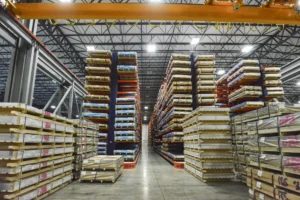
Many metal forming facilities assume floor storage is the only option and plan facility expansions to accommodate growth. Engineered coil racking systems offer an alternative that most operations don’t realize exists — one that addresses both accessibility and safety through vertical storage and independent coil positioning. Before you add square footage, it’s worth seeing how much the coils you already have could move faster.
The Accessibility Problem in Floor Storage
Floor-stored coils take up space and make it more complicated to retrieve the coils your team needs for production.
Multiple Moves Required
Coils in shared positions may require several moves before operators can reach the requested material. Traditional pyramid stacking arrangements — where coils are stacked in layers using floor chocks or saddles — require moving multiple coils to access material deeper in the stack. Repositioning adjacent coils also requires temporary operating space for loads, handling equipment, and operators. Without planned clearance, retrieval activity can interfere with traffic flow and designated egress routes.
Blocked Access and Navigation
Temporary staging can obstruct routes across the warehouse workflow and limit storage density. Under Occupational Safety and Health Administration 29 CFR 1910.176(a), aisles and passageways must remain clear and in good condition.
To meet this requirement and avoid impeding movement, planners need to consider allocating appropriate staging areas in the layout for easier access. A more organized footprint can support greater storage density while preserving planned clearances for retrieval routes and designated aisles.
Longer Travel Paths
Operators often cross the whole storage floor between pulls to find the next coil. Every extra foot of coil and forklift travel is time the press isn’t getting fed. Positioning coils according to production flow can shorten the routes between storage and the point of use.
What Poor Access Actually Costs
Every minute spent searching, waiting, traveling, or moving coils a job didn’t ask for is a minute the requested coil isn’t moving toward the press. That shows up in three places:
1. Slower Order Fulfillment
The press or next production step may wait while operators locate the coil, create access, and reposition adjacent material. Reducing avoidable steps between the request and delivery can improve order fulfillment speed by shortening the interval between material demand and availability.
2. More Handling, More Risk
Every extra move is another chance to scrape a coil’s surface, crush an edge, or damage wrapping — and another moment a multi-ton load is in motion near operators and forklift traffic. Coils store energy and can roll or shift, so fewer moves mean fewer chances for both material damage and a worker ending up in the path of one.
Damage and suspected damage also add cost through extra inspection, rework, scrap, replacement material, and downstream disruption.
3. Wasted Labor Hours
Loading, shifting, and returning unrequested coils consume operator and forklift capacity without advancing the required material. Removing avoidable retrieval steps improves material handling efficiency and makes more labor capacity available for production-supporting work.
How Engineered Storage Fixes Accessibility
Engineered coil storage addresses accessibility by implementing a configuration designed around the material, facility, and retrieval process. Treating storage as infrastructure, not just equipment, means design choices directly influence daily operating performance.
1. Direct Access Without Moving Other Coils
Project-specific coil rack systems can provide independent access where the coil profile, handling method, and layout support it. Direct access reduces relocation of adjacent material. Widespan shelves may incorporate coil cradles and entry features designed around the facility’s handling equipment. Widespan systems can accommodate coils stored eye-to-the-aisle (horizontal orientation) using individual cradles, eye-to-the-sky (vertical orientation) with waterfall decking, or combination configurations for operations using both methods.
When storage orientation matches production requirements, facilities avoid unnecessary coil repositioning during changeover. In an engineered racking retrieval model, the process can be reduced from 30 minutes to around five minutes for location and change-out.
2. Organized Layout and Clear Pathways
Arranging coils in assigned positions helps your team identify the required coil before retrieval begins. And because each coil sits in its own known spot, you can finally pull older stock first when the material calls for it — something pyramid stacking makes impossible, since the coil you need is usually the one buried at the bottom. Planned storage zones can support more consistent routes as inventory changes, while aisle clearances follow the facility’s material flow and handling requirements.
3. Optimized Space Utilization Without Sacrificing Access
Vertical storage helps consolidate your inventory and position material closer to its point of use. A project-specific widespan system may use fewer vertical columns where load, span, shelf, and layout requirements allow. When considering space, look at storage density alongside retrieval routes and equipment clearances. Consolidating also frees the floor space and the buffer inventory that poor access forces facilities to carry — inventory that otherwise ties up working capital and storage positions.
Before vs. After: A Hypothetical Comparison
Having assigned positions improves storage retrieval efficiency by giving your operators a defined route from each position to the production area. The following is a simplified model, not a quote. It compares disorganized floor storage with engineered racking to show how recovered time can add up. These figures are rough estimates, and the actual performance depends on your facility’s current organization, processes, and conditions.
| Retrieval measure | Floor storage | Engineered racking |
| Time per coil | Approximately 30 minutes to locate coils | Coil change-out reduced to as little as five minutes |
| Moves per coil | Multiple moves | Fewer moves |
| Daily time impact at 50 retrievals/change-outs | Baseline | Potential recovery of 1,250 minutes, or almost 21 hours |
In this hypothetical example, using a provisional fully loaded rate of $150 per hour, nearly 21 recovered hours could represent about $3,125 in daily operating value. Across 280 operating days, the annual value could approach $875,000 in a facility transitioning from poorly organized floor storage to engineered racking. Realized savings depend on how the facility uses the recovered capacity and the current state of your storage organization.
The labor calculation is only the starting point and assumes significant baseline inefficiencies. When retrieval delays reduce press uptime or affect production scheduling and downstream fulfillment, the cost of poor access can compound across the operation.
Actual process time depends on coil dimensions, orientation, handling equipment, layout, staging practices, and the final storage configuration. Management typically evaluates recovered time alongside equipment costs, production delays, damage-related expenses, installation investment, and anticipated payback. Access isn’t a back-office detail. It’s a throughput, safety, and cost metric, and the storage design is what decides which way it goes.
Why Dexco® Is Your Trusted Coil Storage Resource
At Dexco, we engineer coil storage to accommodate material movement throughout the facility. For more than 60 years, we’ve designed structural I-beam storage systems for metal formers and fabricators, including notable customers such as Novelis, Whirlpool, Raynor, and Trane. Our process begins with coil dimensions and weights, handling equipment, floor constraints, and the required retrieval workflow.
Our systems are engineered using the American Institute of Steel Construction standards, the same standards used for bridges and buildings, so you can be confident that our parts meet high-end structural design requirements. We also maintain ISO 9001:2015 certification.
As a winner of a 2026 Plant Engineering Silver Award in the “Safety, Security and Risk Mitigation” category, our approach gives you greater peace of mind with storage designed for predictable, long-term performance in real operating conditions.
Get Engineered Coil Storage From Dexco®
The best recommendation for your facility starts with your coil specifications, handling equipment, and floor constraints. Reviewing your layout options now helps you evaluate direct access and retrieval predictability before storage decisions become difficult to reverse. Learn more about how engineered storage can eliminate pyramid stacking risks while improving your operation’s consistency and output.