Every growing manufacturer eventually reaches the same conclusion: “We’re out of space.’
Production has increased. Inventory levels have grown. Aisles feel tighter. Forklifts are navigating around stacks of material. Floor space that once seemed abundant has become increasingly difficult to find. At that point, conversations often turn toward expansion.
Should we lease additional warehouse space? Build an addition? Move to a larger facility?
Sometimes the answer is yes. But before making a significant investment in more square footage, it’s worth asking a different question: Is the facility truly out of space, or is it simply not using its existing space as efficiently as possible?
In many cases, the limiting factor isn’t the building itself. It’s the storage strategy.
The Hidden Cost of Warehouse Congestion
Warehouse congestion rarely appears overnight. It develops gradually as inventory grows and available storage locations become harder to find. The first signs of a congestion problem are often operational rather than spatial.
Forklift operators spend more time maneuvering around obstacles. Materials get staged in temporary locations because permanent storage is unavailable. Travel paths become longer. Retrieving inventory takes more time. Production teams spend extra effort locating material that should be easy to access. While these inefficiencies may seem minor individually, they add up quickly.
Congestion can impact:
- Labor productivity
- Material flow
- Inventory visibility
- Forklift travel time
- Order fulfillment speed
- Workplace safety
When employees and equipment must work around stored inventory, the entire operation becomes less efficient. The irony is that many facilities experiencing congestion aren’t necessarily at capacity. They’re simply running out of usable storage capacity.
The True Cost of Storing Material on the Floor
When storage locations become scarce, floor storage often becomes the default solution. At first glance, it seems practical. The space is available, the material is accessible, and no new infrastructure is required. “It makes it easier to find what you need,” is an oft-used explanation.
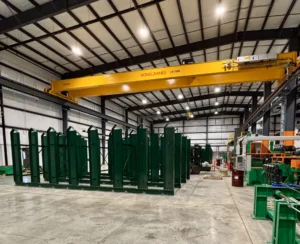
But the fact of the matter is, floor storage carries costs that aren’t always obvious. Material stored directly on the floor consumes valuable operational real estate. Every pallet, bundle, coil, or stack of inventory occupies space that could otherwise support production activities, staging operations, shipping functions, or equipment movement.
Floor storage can also create additional challenges:
- Increased risk of product damage
- Reduced inventory visibility
- More difficult material handling
- Heightened risk to employee safety
- Longer retrieval times
- Greater congestion in high-traffic areas
Perhaps most importantly, floor storage often becomes permanent. What begins as a temporary solution can gradually evolve into the standard operating procedure, reducing overall facility efficiency – and increasing worker safety risks – year after year.
For manufacturers focused on productivity, floor space is often the most valuable space in the building. Using it primarily for storage simply may not be the best use of the asset.
Are You Paying for Air?
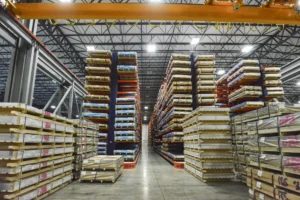
Most facility discussions focus on square footage. But warehouses and manufacturing facilities are three-dimensional assets. You pay to heat, cool, light, insure, and maintain the entire building volume, not just the floor. Yet, many facilities utilize only a portion of their available vertical space.
The reason is rarely ceiling height. More often, it’s because the storage system was designed for a different inventory mix, a different production environment, or at a different stage of the company’s growth. As a result, significant storage capacity may exist overhead while materials continue to accumulate on the floor below.
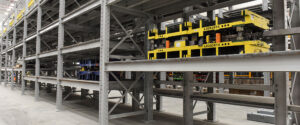
This is where evaluating warehouse capacity becomes particularly important. A facility that appears full at ground level may still have substantial unused storage potential within its existing footprint. In some cases, organizations discover that improving vertical storage utilization provides enough additional capacity to postpone or eliminate the need for expansion.
When Expansion Makes Sense (and When It Doesn’t)
There are certainly situations where facility expansion is the right decision. For example, a growing business may need additional production lines. Shipping volume may exceed dock capacity. New operations may require more manufacturing space than the current building can support.
But storage-related space constraints deserve closer examination, especially before committing to new construction or long-term leases. A useful question to ask is: If all inventory were stored in the most appropriate way for its size, weight, handling requirements, and turnover rate, would we still need more space?
Many manufacturers are surprised by the answer.
Inventory is often stored according to historical practices rather than current operational requirements. Materials with vastly different dimensions and handling needs may be forced into the same storage system. Frequently accessed inventory may be stored no differently than material that moves only occasionally. When storage systems are aligned with the characteristics of the material being stored, organizations often uncover capacity that was already available, but just not utilized properly.
Capacity Is Only Part of the Equation
The most successful storage strategies don’t simply create more room; they improve the overall operation. A well-designed storage system can help organizations:
- Improve safety
- Protect inventory from damage
- Increase storage density
- Reduce travel distances
- Improve inventory visibility
- Support future growth
- Streamline material handling
That’s why the conversation shouldn’t be limited to how much material a facility can store. The more important question is how effectively the facility can support the people, processes, and equipment that keep the business moving.
Before You Build, Look Up
When a facility feels crowded, it’s natural to assume more space is needed. Sometimes that’s true. But before investing in additional square footage, it’s worth evaluating whether the current storage strategy is making full use of the space already available. One of the biggest opportunities often lies overhead.
Many manufacturing facilities utilize only a fraction of their available space, simply because their storage systems weren’t designed to take advantage of the building’s full height. Instead, materials remain on the floor, consuming valuable operating space while the air above them goes unused.
Unlocking that capacity isn’t simply a matter of stacking inventory higher. Effective vertical storage requires careful consideration of the material being stored, load weights, handling methods, equipment reach, building clearances, and day-to-day accessibility. When those factors are engineered together, manufacturers can often increase storage capacity dramatically within the same footprint, while also improving safety, reducing congestion, and making material easier to access.
In many cases, the capacity you’re looking for is already inside your building. The challenge is designing a storage system that allows you to use it safely and efficiently.
If you’re wondering whether your facility is truly out of space, or simply not making the most of the space you already have, the Dexco team can help. Our engineers work with manufacturers every day to evaluate existing storage layouts, identify opportunities to improve capacity and material flow, and design purpose-built storage systems that support safer, more efficient operations.
Before you commit to expanding your warehouse, let’s explore how much more your current facility can do. Contact Dexco to schedule a storage review and start uncovering the capacity that’s already there.