A storage system can be perfectly adequate when it is installed and eventually become a poor fit as the business around it changes. Businesses evolve; that’s only natural. Production can increase, and inventory can grow. Materials change as new products are introduced. What once seemed like generous storage capacity can gradually become a constraint on the entire operation.
The problem is that facilities don’t always recognize when that transition is happening. By the time storage capacity becomes a problem that can’t be ignored, the operation may already be dealing with congestion, inefficient material handling, and unsafe floor storage issues — all making it increasingly difficult to access inventory safely and efficiently.
The better approach is to look for the warning signs early. Start now by evaluating not only what your facility needs today, but what it is likely to need five years from now. Here are 7 warning signs to watch for:
1. Floor Storage Is Becoming the Norm
One of the clearest signs that a storage system is no longer keeping pace with actual need is the gradual migration of materials onto the floor. It often starts innocently enough. A few items don’t have a permanent storage location, so they’re temporarily staged nearby. As inventory increases, more materials end up in those temporary locations. Eventually, temporary floor storage becomes part of the normal, accepted workflow.
The problem is that floor space is doing more than storing inventory. It is also needed for production, material movement, staging, equipment, and employee access. When storage begins consuming an increasing share of that space, congestion can spread throughout the facility. Floor storage can make materials harder to organize, access, and track — while also increasing the potential for material damage and unsafe working conditions.
If materials are regularly being stored wherever space happens to be available, that’s a strong indication that it’s time to reassess your storage system instead of simply finding another open space for the next shipment.
2. The Materials You Store Have Changed
A storage system designed around yesterday’s inventory may not be appropriate for today’s. Perhaps the business is handling larger or heavier components. Maybe product lines have expanded, creating a wider range of material sizes. Or the operation could now be storing more specialized items that require different access and handling methods.
These changes matter because storage requirements aren’t determined by volume alone. The dimensions, weight, shape, and handling requirements of the material all influence the type and configuration of storage needed. A system that works well for one material profile may be inefficient or unsuitable for another.
Storage reviews shouldn’t begin with the question, “How many more rack locations do we need?” They should begin with, “What are we storing now, and how is that different from what we were storing when the current system was designed?”
3. Material Flow Is Getting Harder
Storage capacity isn’t useful if employees and equipment can’t efficiently access what’s being stored. Longer travel distances, increasingly crowded aisles, difficult forklift maneuvering, and materials that are constantly being moved out of the way are all signs that a storage system may no longer align with the operation’s workflow.
A growing business can change its material flow significantly over time. Production volumes may increase, frequently accessed materials may change, and new equipment may require different aisle widths or turning clearances. An effective storage layout needs to account for those changes.
Our recent guide to optimizing warehouse racking layouts provides a useful framework for evaluating flow, accessibility, space, and throughput together, rather than treating storage capacity as an isolated measurement. Check it out at the link for more.
4. You’re Constantly Rearranging the System
Another warning sign can be surprisingly easy to overlook: the organization is seemingly always changing the storage system. Rack levels are moved, materials are shuffled between locations, and temporary staging areas appear and disappear. Employees develop workarounds for storing items that don’t fit where they are supposed to go. Flexibility is valuable, but continually modifying a system just to accommodate basic operational needs is a red flag and a strong sign that the system itself is no longer flexible enough.
A storage system should be capable of adapting as the business changes. That might mean adjustable configurations, additional capacity, different rack types, or a combination of systems designed around different material requirements. The goal isn’t to eliminate change; that would be impossible. It’s instead to make sure the storage infrastructure can accommodate reasonable changes without requiring the facility to reinvent its layout every time inventory or production requirements shift.
5. Your Inventory Forecast Is Growing Faster Than Your Storage Capacity
This may be the most important sign (and the one that requires looking beyond today’s facility).
If production, inventory, or material requirements are expected to increase substantially over the next several years, today’s available capacity cannot be the only benchmark you use. A facility with 20% of its storage capacity remaining may look comfortable now, but if inventory is expected to grow significantly, remaining capacity could disappear much faster than anticipated.
This is why storage planning should be tied to the same forecasts used to plan production, purchasing, and facility operations.
It’s a good idea to ask the following:
- How much inventory do we expect to carry in one year?
- What about three years?
- What does the five-year outlook look like?
- Are we introducing new products or materials?
- Are average inventory levels changing?
- Could purchasing or supply-chain strategies require us to carry more material?
- Will production volumes or throughput change?
No one can predict the future. But what you can do is make sure the storage system isn’t designed exclusively around a rigid snapshot of the present.
6. You’re Not Using Your Facility’s Capacity Efficiently
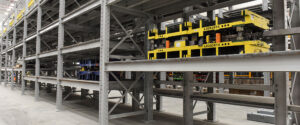
Sometimes the problem isn’t that the facility has too little space. It’s that the storage system isn’t making the best use of the space available. Manufacturing facilities are three-dimensional environments, but storage strategies often focus primarily on the floor area. That can leave significant vertical capacity unused, while materials continue to occupy valuable floor space.
Vertical storage can be an important part of a long-term capacity strategy, but simply adding height isn’t enough. Rack configuration, load requirements, building clearances, material-handling equipment, and accessibility all need to be considered together.
We recently discussed using warehouse ceiling height to its full potential and how vertical density can help facilities increase storage capacity without increasing their footprint (give it a read for more advice). The bottom line is that capacity should be evaluated in terms of the facility’s total usable volume, not just its square footage.
7. You Don’t Have a Five-Year Storage Plan
Perhaps the biggest sign that a storage system needs to be reconsidered is that no one can answer this simple question: “How much storage capacity will we need five years from now?”
If the answer is “We’ll figure it out when we get there,” then the facility may already be behind.
A five-year storage plan doesn’t need to be an exact prediction. Instead, it should establish a realistic picture of how the operation could evolve, identifying which elements of the storage system need to accommodate that growth.
Here’s how to get started:
- Start With Today’s Baseline: Document what you have now: inventory volume, storage locations, rack capacity, floor space, vertical space, material dimensions and weights, throughput and handling requirements. This creates a starting point for measuring change.
- Project Business Growth: Look at the same factors the business already uses to forecast growth: production, inventory, sales, new products, purchasing requirements, and anticipated changes in operations. Then translate those projections into storage requirements.
- Consider How the Inventory Mix Will Change: Growth isn’t always linear. Ten percent more inventory doesn’t necessarily mean ten percent more storage space. If the additional inventory consists of larger, heavier, or differently shaped materials, the storage requirement could change much more significantly. The same is true if access requirements or material flow change.
- Build in Flexibility: A system designed precisely around today’s inventory may require another major investment when the business changes again. A more forward-looking approach considers whether the storage system can be expanded, reconfigured, or adapted as requirements evolve. Scalability should also be considered as part of the initial investment. Dexco’s racking and material-handling equipment budget guide discusses why future growth, customization, and long-term cost of ownership belong in the planning process rather than being treated as afterthoughts.
- Plan for the Business You’re Becoming: Outgrowing a storage system doesn’t happen at a single moment; it’s usually a gradual process. The warning signs appear first: materials begin accumulating on the floor. Aisles become more difficult to navigate. Employees spend more time moving inventory. The material profile changes. Storage configurations are repeatedly modified. And the business’s growth projections begin to exceed the assumptions behind the existing system. Recognizing those signals early creates an opportunity.
Instead of reacting to a storage shortage, manufacturers can evaluate their current facility, understand where capacity is being lost, and design a storage strategy around the operation they expect to have in the years ahead. That may involve better use of vertical space. It may mean changing rack configurations, adding specialized systems, or redesigning material flow. In some cases, expansion will ultimately be necessary. But the important thing is to make that decision based on a clear understanding of future requirements, not because the last available storage location has already disappeared.
The best time to evaluate your storage system isn’t when you’ve run out of room. It’s while you still have the flexibility to plan.
Dexco works with manufacturers to evaluate their storage requirements, facility layouts, and material-handling needs and develop purpose-built industrial storage solutions designed around the way their operations work today — and how they expect them to grow tomorrow. Drop us a line here if you’d like to learn more about what we can do for you.