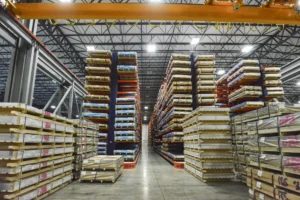
When planning an industrial storage system for your facility, one of the most important questions is also one of the easiest to oversimplify: How much weight can the rack safely hold?
The answer isn’t simply the total weight of the material you want to store. Safe load requirements depend on the type of material, how that material is distributed, the configuration of the storage system, the rack components supporting the load, the building and floor conditions, and how the material will be placed and retrieved.
All of this adds up to make load capacity one of the most important parts of storage-system design, and one that should be evaluated before a rack is purchased or installed.
Start With the Material
The first step is understanding what the storage system actually needs to support. For each material type, identify the following:
- Maximum unit weight
- Typical unit weight
- Dimensions and shape
- Number of units stored together
- How the material is positioned or supported
- How many loads will be stored at each level
- How frequently the material will be accessed
The maximum load matters, but it isn’t the only consideration. A rack designed around a 5,000-pound load may not be appropriate simply because another 5,000-pound load weighs the same. A concentrated load, an unevenly distributed load, a long load or a load with a specialized support requirement can place very different demands on the same storage system.
This is particularly important for industrial materials such as steel coils, dies, tooling, pipe, plate and other heavy or irregularly shaped products.
Calculate the Load at the Storage Level
Once the material profile is understood, determine the load each rack level will actually carry. For example, if a storage level holds four units weighing 2,500 pounds each, the total stored load is 10,000 pounds, assuming the system is designed for that configuration and the load is appropriately distributed. That number, however, shouldn’t automatically be treated as the rack’s required capacity.
The design also has to account for how the load is transferred into the rack structure, including the beams, arms, uprights, connections and other supporting components. Load capacity is a structural calculation, not simply a weight limit assigned to an open space. That is why rack capacity should be established for the specific configuration and loading conditions, rather than relying on a generic rating.
Don’t Forget the Floor
The rack isn’t the only thing carrying the load. Ultimately, the weight of the storage system and its contents is transferred through the rack structure and anchors into the building’s floor. The concrete slab therefore becomes part of the load-capacity equation.
Concrete thickness, strength, condition, and the location of the rack can all matter. Heavy storage systems can create significant point loads at rack uprights, concentrating forces in relatively small areas. If the slab isn’t capable of supporting those loads, the consequences can include cracking, settling or anchor problems.
This is why reviewing available information about the floor (and obtaining an additional expert evaluation or testing when necessary) should happen before installation rather than after problems appear.
Account for the Building and Environment
A safe load calculation also needs to consider the environment in which the storage system will operate. Depending on the facility and location, that can include:
- Building structure and column locations
- Seismic conditions
- Rack height and configuration
- Anchorage requirements
- Fire protection and sprinkler clearances
- Aisle and equipment clearances
- Applicable building codes and permitting requirements
These factors can influence the final design even when the material weight itself hasn’t changed. Industrial racking is a structural system, which is why standards such as ANSI/RMI specifications play an important role in establishing appropriate design and engineering practices. Building codes and local requirements may also affect the design.
Consider How the Load Will Be Handled
A storage system doesn’t operate in isolation. Forklifts, cranes, hoists, and other material-handling equipment interact with the rack every day. The equipment’s capacity, reach, operating clearances and method of loading and unloading can all affect how the system needs to be configured. It’s not uncommon for the same material to require a different storage solution depending on whether it is handled by forklift, overhead crane, or another method.
Safe storage also requires enough clearance for the equipment and operators to move materials without creating additional hazards. OSHA 1910.176 specifically addresses safe clearances for mechanical handling equipment and requires stored materials to be stable and secure against sliding or collapse.
Don’t Confuse a Load Rating With a Safe System
Perhaps the most important point is that a rack’s rated capacity should never be viewed as a standalone number. A storage system can only be considered appropriately designed when the loads, rack configuration, floor, building conditions, handling equipment, and applicable requirements have been considered together, as parts of a whole.
That also means existing racks shouldn’t automatically be assumed to have the capacity needed for a new application, simply because they have supported similar-looking material in the past. Changing the load, increasing the number of storage levels, modifying rack dimensions, or even changing how material is positioned can change the structural requirements.
Additionally, if a rack is damaged, overloaded or being used differently from its intended application, the correct response isn’t to estimate how much weight it can probably handle. The system should be comprehensively evaluated before continuing to use it.
Safe Capacity Starts With Better Information
Calculating safe load requirements begins with good information: what you’re storing, how much it weighs, how it’s supported, how often it moves, and what equipment will handle it. From there, the storage system can be engineered around those actual conditions, including the rack structure, floor, building, and operating environment.
Storage systems need to be designed with a capacity that truly is appropriate for the unique material, specific facility, and way the operation actually works. When heavy industrial materials are involved, that distinction matters. Safe load capacity can’t be a guess, a rule of thumb or a number pulled from a catalog.
If you’d like to know how Dexco’s 50+ years of experience delivering safe, efficient and reliable storage solutions can help your organization, drop us a line here.